

Blog
IVF with Sperm Donor Success Rates
 Victoria
Table of contents
For women who do not have a male partner, as well as couples in which the man has significant alterations in semen quality or genetic diseases that cannot be detected by means of Preimplantation Genetic Diagnosis (PGD), IVF with a sperm donor may be the most appropriate solution to conceive a healthy baby.
If you are considering sperm donation, it is important that you know what this treatment is like and what legal and medical aspects guarantee its safety and effectiveness.
How IVF with Donor Sperm Works
The aim of IVF is to obtain the best mature eggs to be fertilised by sperm. In the case of IVF with donor sperm, the treatment for the patient is the same as for IVF with the patient’s own gametes. What changes is that, in the laboratory, instead of using the partner’s sperm, we will use a donor’s, following this procedure:
1-Selection of the sperm donor
The first step in the IVF procedure with a sperm donor consists precisely in choosing the donor, which in Tambre’s case will be from our own sperm bank, in which all samples are frozen for a minimum of six months after collection, in order to ensure the absence of transmissible infections.
By law, sperm donors in Spain must be in good physical and mental health, within certain age limits (generally between 18 and 35), have no family history of hereditary genetic diseases, and no history of sexually transmitted diseases. In addition, the semen sample must be of excellent quality, above the reference values established by the WHO.
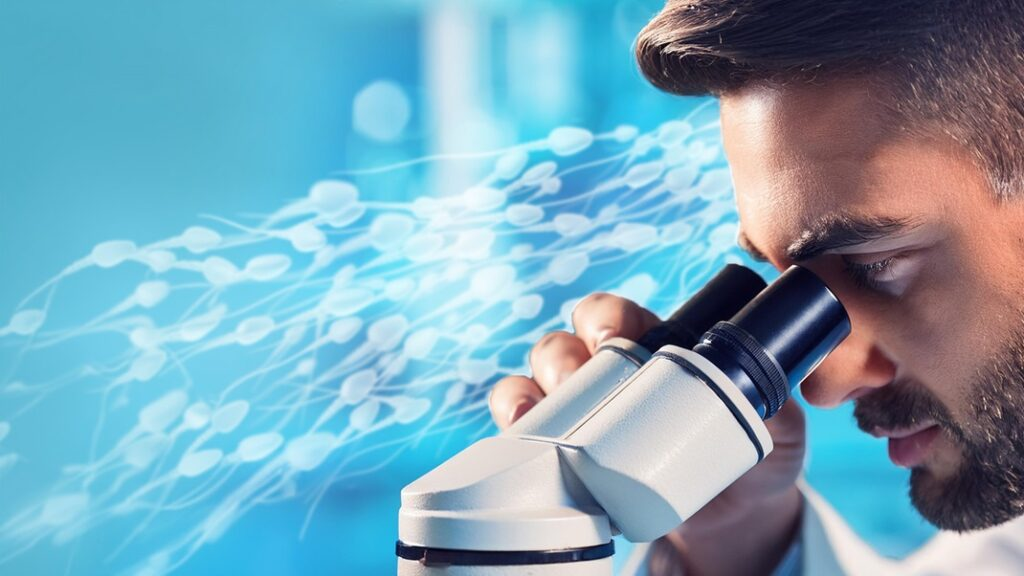
Furthermore, according to Spanish law, donors are selected among those who resemble the mother. Therefore, we select donors who match the recipient’s physical features, blood type, and ethnicity. It is also worth remembering that sperm donation is anonymous, which means that both donors and recipients have no access to each other’s identity.
2-Ovarian Stimulation
As in conventional IVF, we perform a process of controlled ovarian stimulation, which consists of administering medication to the woman to stimulate the production of mature eggs in the ovaries.
During this stage of stimulation, which at Tambre is fully personalised, we closely monitor the development of the eggs by means of ultrasound scans.
3-Egg Collection (Follicular Puncture)
When the eggs reach maturity, a procedure called follicular puncture is performed to extract the eggs from the ovaries using ultrasound imaging. The fluid from the follicles is aspirated through a fine needle inserted via the vagina while the patient is under sedation. This follicular fluid is analysed in the laboratory to obtain the eggs.
4-Fertilisation (Ovum vitrification)
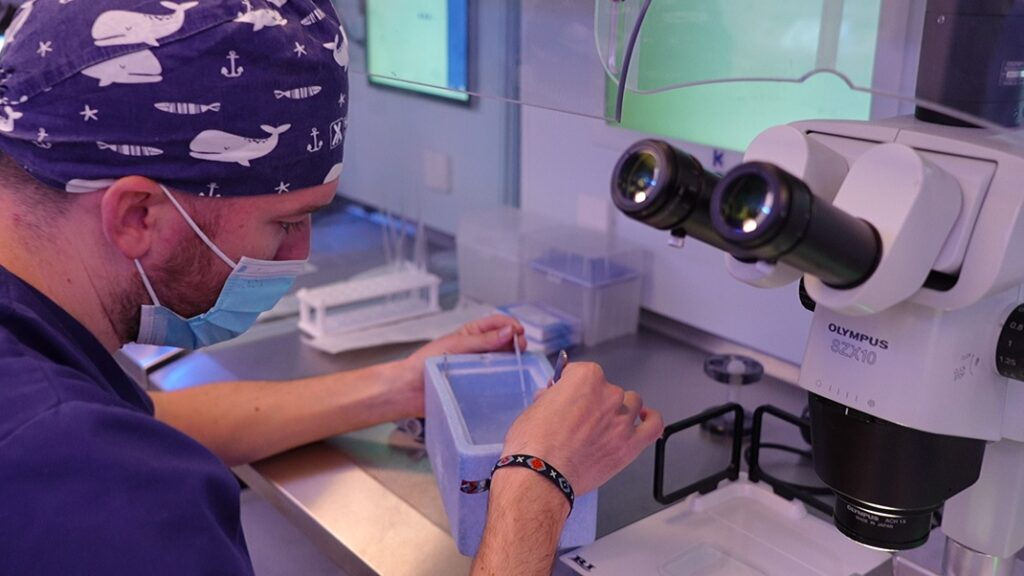
Once we have the patient’s eggs, it is time to thaw the semen sample, which is processed in our andrology laboratory. The retrieved eggs are then combined with the donor’s sperm in the embryology laboratory, either by conventional IVF, where eggs and sperm are placed together in a laboratory dish to allow fertilisation to occur naturally, or we can resort to intracytoplasmic Sperm Injection (ICSI) which consists of selecting a spermatozoon that is introduced into the egg in order to achieve fertilisation.
5-Embryo culture
After fertilisation, the resulting embryos are incubated in the laboratory for 2-6 days to allow them to develop, at which time they are ready for transfer or, in some cases, for freezing.
At Tambre we have time-lapse incubators, which enable continuous monitoring of each embryo 24 hours a day. This avoids the need for embryologists to remove the plates from the incubator to check the status and development of the embryos under the microscope. In this way we manage to maintain the embryo’s conditions as stable as possible, avoiding its manipulation, exposure to light, and temperature changes.
6-Endometrial preparation
The endometrium is the layer that lines the inside of the uterus and is primarily responsible for the implantation of embryos so that pregnancy can occur. At Tambre we understand that this factor is key to the success of IVF treatment with sperm donors. That is why we perform a fully customised endometrial preparation. By means of oestrogen and progesterone medication, we help the endometrium acquire a trilaminar appearance and a thickness equal to or greater than 7-8 mm, which allows us to optimise embryo implantation.
7-Transfer of embryos
Finally, one of the selected embryos is transferred to the woman’s uterus. In order to minimise the risk of multiple pregnancy, at Tambre we always recommend single embryo transfer.
Embryo transfer is a procedure that is usually quick and painless, similar to a gynaecological examination. At Tambre, the transfer is always carried out on day 5 or 6 of embryonic development, at the blastocyst stage. The exact day of transfer will depend on each patient’s individual circumstances and the characteristics of the treatment cycle.
Once the transfer has taken place, we can prescribe medication to support the uterine lining and promote implantation and early development of the pregnancy. If embryos are not transferred, they will be cryopreserved by vitrification for future cycles, without the need to repeat the ovarian stimulation or follicular puncture.
8-Pregnancy test
12-15 days after the embryo transfer, a pregnancy test is performed by determining the beta-hCG (human chorionic gonadotropin), which will indicate whether the in vitro fertilisation procedure with donor sperm has been successful.

Sperm donor IVF success rates
The success rates of IVF with donor sperm will depend, above all, on the age of the mother-to-be, as well as the quality of her eggs. Since the sperm is donor sperm, it will be of good quality, so the success of the treatment will depend on the quality of the egg.
The success of IVF treatment with donor sperm is also influenced by the characteristics of the uterus and the preparation of the endometrium, the conditions under which the embryo culture is performed, whether the embryos are vitrified prior to transfer, and also the number of embryos transferred.
We specialise in Advanced Reproductive Medicine and we go beyond standardised procedures, offering fully personalised treatments that allow us to achieve better results and success rates in IVF treatment with sperm donation.
Take the first step towards your pregnancy
Contact us today to schedule your first consultation at Tambre on +44 (0) 20 38 688 650. During your first consultation you will meet your fertility specialist gynaecology team who will accompany you throughout the process and carry out the essential tests so that you can find out what your best options for achieving pregnancy are, including IVF with donor sperm.
Our team will guide you from the very beginning with a personalised and supportive medical approach.