
blog tambre
Endocrine disruptors and fertility: Tambre presents a study at ESHRE 2026 on their presence in the oocyte environment
 Victoria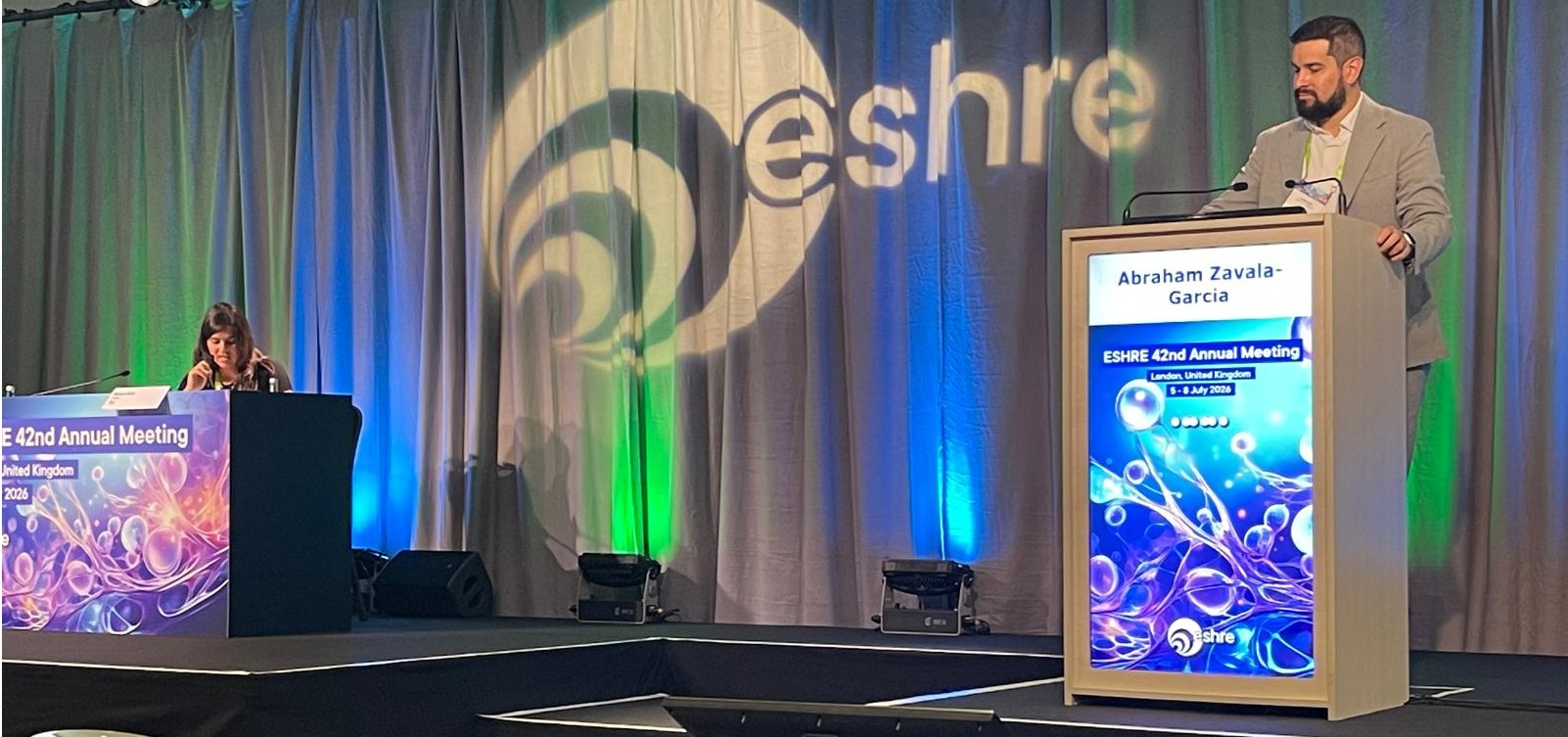
Table of contents
Tambre has once again taken part in the annual congress of the European Society of Human Reproduction and Embryology, ESHRE 2026, held in London from 5 to 8 July. This is one of the most important international meetings in reproductive medicine, where specialists from around the world share the latest scientific, clinical and technological advances in fertility.
This year, Tambre was represented by a multidisciplinary team led by our CEO, Inge Kormelink, together with professionals from Tambre Madrid and Tambre Alicante: Dr Abraham Zavala, new Scientific Director of Tambre and its Foundation; Dr Najib Dagher; Ana Ballester, Nursing Coordinator at Tambre Alicante; Raquel Urteaga, Head of the Emotional Support Unit; embryologists Carolina Andrés, Sara Díez and Victoria Almela; and Inci Ipek and Inmaculada Olid, from the international business development team.
During the congress, Tambre presented two scientific studies developed by its teams. One of them, selected as an oral communication, addressed an increasingly relevant issue in assisted reproduction: everyday exposure to endocrine disruptors and their possible presence in the oocyte environment.
The study, entitled Avoidable lifestyle exposure to endocrine disruptors with potential impact on fertility: a pilot study, was presented by Dr Abraham Zavala, Scientific Director of Tambre and its Foundation. The study analyses how certain everyday products may leave traces in the body and, particularly significantly, in the follicular fluid: the fluid that surrounds the oocyte during its development.
What are endocrine disruptors?
Endocrine disruptors are chemical substances that can interfere with the hormonal system. They may be found in many commonly used products, including certain cosmetics, personal care products, packaging, plastics, cleaning products, menstrual hygiene products and other materials we come into contact with in daily life.
Their relevance in fertility is not only that they are present in our environment, but that exposure can occur repeatedly and often go unnoticed. In many cases, it is not a question of one single source, but rather of small daily contacts that accumulate over time.
For this reason, the aim of this study is not to cause alarm. Quite the opposite: it seeks to provide useful information, prevention and practical tools so that patients can make more informed decisions about their reproductive health.
A pilot study looking beyond treatment
The work presented by Tambre is based on a very specific idea: to better understand how certain daily habits and commonly used products may contribute to avoidable exposure to endocrine disruptors.
The research was carried out in 20 women of reproductive age undergoing ovarian puncture. Urine samples were collected from all participants and, in 19 cases, follicular fluid samples were also collected. In addition, a structured questionnaire led by the nursing team was used to identify possible sources of exposure in everyday life, including personal care products, intimate hygiene, menstrual hygiene, cleaning products and dietary habits.
This approach makes it possible to connect scientific research with something that is highly relevant in clinical practice: understanding each patient’s context more thoroughly.
In reproductive medicine, treatment is not the only thing that matters. The patient’s story, habits, environment and all the factors that may help us better understand each case also matter.
Presence of biomarkers in urine and follicular fluid
The study results showed that at least one endocrine disruptor biomarker was detected in 100% of the urine samples analysed. At least one biomarker was also detected in 100% of the available follicular fluid samples.
“In urine, we analysed metabolites, which tells us that the exposure is not old or isolated, but recent and probably ongoing,” explains Ana Ballester, Nursing Coordinator at Tambre Alicante and principal investigator of the study.
For Ballester, one of the most important aspects of this work is that it highlights a reality that is difficult to perceive in everyday life: “We are dealing with an invisible exposure. Patients are not aware that these compounds are present in products they use every day”.
Among the findings, biomarkers of DEHP, a compound associated with certain plastics, were present in all the urine and follicular fluid samples analysed.
The study also identified different families of substances, including bisphenols, PFAS, dioxins, parabens, phthalates and benzophenones. In urine, these families were detected in 90% of participants. In follicular fluid, some of them also appeared with high frequency.
One of the most relevant aspects of the study is precisely the detection of biomarkers in follicular fluid. This finding suggests that some compounds may reach the ovarian microenvironment, meaning the immediate environment in which the oocyte develops.
From the perspective of reproductive medicine, this information is particularly valuable because it helps broaden the clinical view. It is not only about studying the embryo, the uterus, the gametes or the most appropriate technique, but also about better understanding the biological environment in which the reproductive process takes place.
Everyday products and accumulated exposure
The study also analysed the everyday products reported by the patients by reviewing their ingredients. According to the data collected, 84.7% of these products contained at least one ingredient with potential endocrine-disrupting activity.
This figure helps explain why exposure can be so frequent. In many cases, it does not come from a single product, but from the combination of different sources present in daily routines: creams, cosmetics, packaging, cleaning products, hygiene products or materials that come into contact with food.
For patients, the main message of this study is clear: there are environmental factors that are not always visible, but which can be acted upon when the right information is available.
Reviewing commonly used products, identifying ingredients, reducing unnecessary exposure or choosing safer alternatives can form part of a prevention and health education strategy within reproductive care.
The value of nursing-led support
One of the most interesting aspects of the study is the role of nursing. The questionnaire used not only made it possible to collect data, but also opened a pathway for more individualised support.
In fact, after completing the questionnaire and receiving the information provided during the study, patients showed greater interest and awareness, reinforcing the role of health education as a tool for prevention.
The research shows that nursing-led health advice can help patients recognise possible modifiable sources of exposure and make more informed decisions during their reproductive journey.
At Tambre, this approach is part of our understanding of advanced reproductive medicine, where science and care go hand in hand. Research also means listening better, asking better questions and providing better support.
A pilot study opening a new line of research
As with any pilot study, this work should be interpreted with caution. The sample size is limited and the design is cross-sectional, so it does not allow causal relationships to be established or direct conclusions to be drawn about the impact of these substances on reproductive outcomes.
The authors point out that larger studies will be needed to assess the clinical relevance of these findings and their possible relationship with oocyte quality, embryo development or the outcomes of assisted reproduction treatments.
Even so, its value is significant. This study provides an initial snapshot of a very widespread form of exposure and opens up a line of research of great interest for reproductive medicine.
It also reinforces an essential idea in Tambre’s approach: research is not only about scientific progress, but also about providing patients with practical, clear and useful information.
In assisted reproduction, every detail matters. And gaining a better understanding of the environment in which the oocyte develops can help us build a more precise, more preventive and more person-centred form of medicine.
ESHRE 2026
Avoidable lifestyle exposure to endocrine disruptors with potential impact on fertility: a pilot study
Ballester A, Sánchez M, Ruano M, Poeiras S, Hernández A, Horcajadas JA, Romero C, Ortega L, Zavala A.
Would you like to better understand what may be affecting your fertility?
At Tambre, we study each case individually, with precise medical insight and compassionate support throughout every stage of the journey.
Request a personalised assessment