

blog tambre
Tambre presents a study at ESHRE 2026 on the role of the oocyte in cases of sperm DNA fragmentation
 Victoria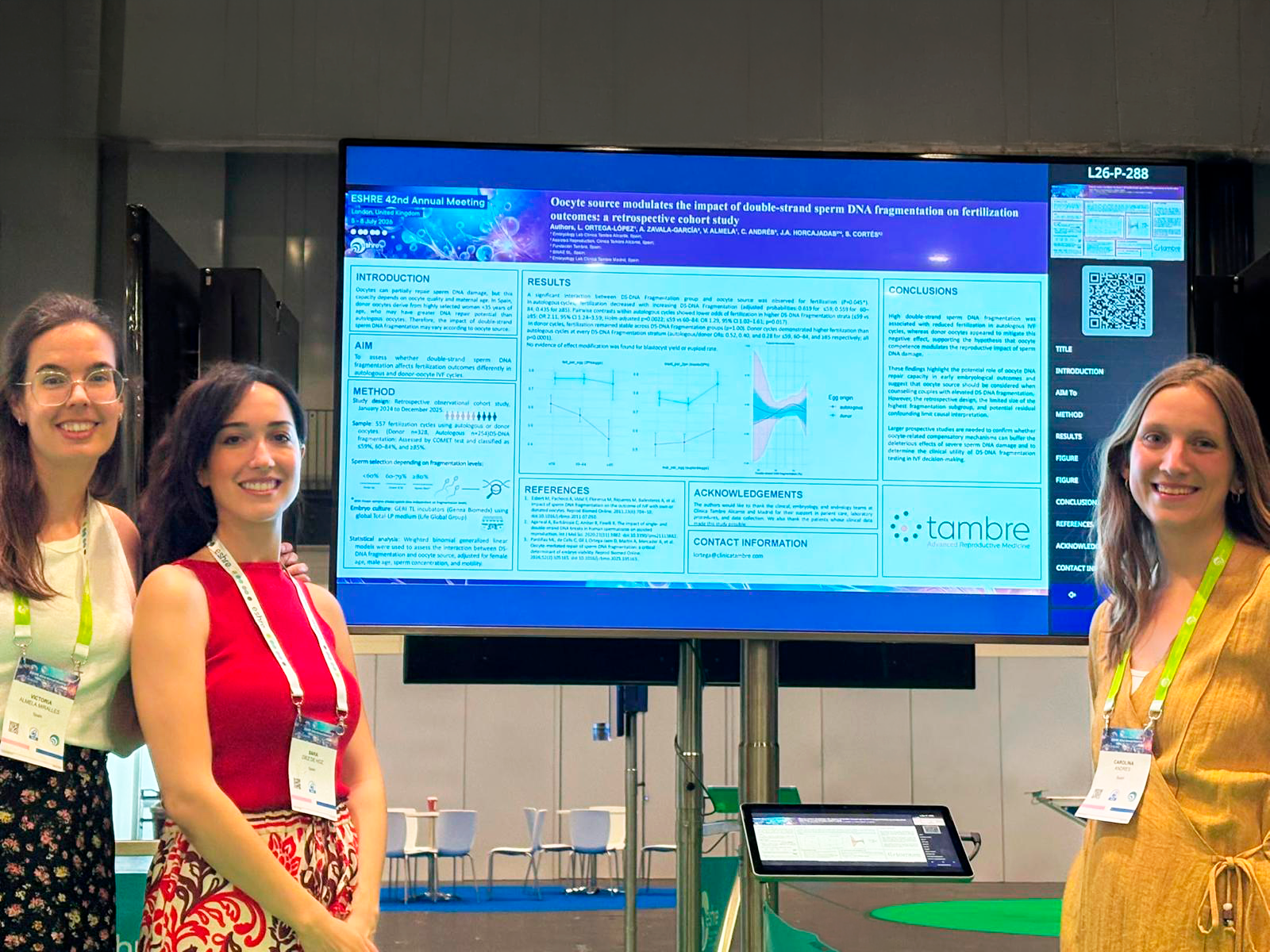
Tambre presents a study at ESHRE 2026 analysing how sperm DNA fragmentation may affect treatments using patients’ own oocytes and donor oocytes differently.
When a couple or patient begins assisted reproduction treatment, one of the most difficult questions often arises after the laboratory stage: why do some oocytes fertilise while others do not? The answer does not always lie in a single factor. Oocyte quality, maternal age, sperm quality and cellular repair capacity may all influence a process which, although it takes place in the laboratory, reflects the biological history of both gametes.
With this approach, Tambre is present at ESHRE 2026, the annual congress of the European Society of Human Reproduction and Embryology, taking place in London from 5 to 8 July 2026. One of the scientific studies being presented is Oocyte source modulates the impact of double-strand sperm DNA fragmentation on fertilization outcomes: a retrospective cohort study, which analyses how double-strand sperm DNA fragmentation may influence fertilisation outcomes and whether this impact changes depending on the source of the oocyte: the patient’s own oocytes or donor oocytes.
Sperm DNA fragmentation is an alteration in the genetic material of the sperm cell. Specifically, double-strand fragmentation affects both strands of the DNA and may play an important role in assisted reproduction. However, its impact does not depend solely on the sperm cell. The oocyte also plays an active role after fertilisation, as it may be able to repair some of the damage to the sperm DNA.
This repair capacity is not the same in every case. According to the study, it depends on oocyte competence and maternal age. Donor oocytes usually come from young, carefully selected women, with better cytoplasmic quality and greater repair capacity. By contrast, cycles using patients’ own oocytes represent a more heterogeneous population, with differences in age, ovarian reserve and oocyte competence.
This distinction is important for patients because it helps explain why the same male factor may not have the same effect in every treatment. It is not only about measuring a semen parameter, but about interpreting it within the complete clinical history.
Study results
The study presented by Tambre is a retrospective observational cohort study that included 557 fertilisation cycles with available data on double-strand sperm DNA fragmentation and complete laboratory outcomes. The cycles were analysed according to oocyte source, differentiating between patients’ own oocytes and donor oocytes. The study period ran from January 2024 to December 2025.
Double-strand sperm DNA fragmentation was assessed using the COMET assay and analysed both by groups and as a continuous variable. The main objective was to study the fertilisation rate. Other laboratory outcomes were also assessed, such as blastocyst development and the euploid embryo rate, meaning embryos with the correct chromosomal complement in cases where genetic testing was available.
The results show a relevant difference between cycles using patients’ own oocytes and cycles using donor oocytes. In cycles with patients’ own oocytes, the fertilisation rate decreased as double-strand sperm DNA fragmentation increased. The adjusted probabilities of fertilisation were 0.619 in the group with the lowest fragmentation, 0.559 in the intermediate group and 0.435 in the group with the highest fragmentation.
By contrast, in cycles using donor oocytes, fertilisation remained stable across the different levels of fragmentation. In addition, cycles with donor oocytes showed higher fertilisation rates than cycles with patients’ own oocytes across all the fragmentation groups analysed.
This finding suggests that oocyte source may modulate the impact of sperm DNA fragmentation on fertilisation. Put simply: when sperm fragmentation is high, the oocyte’s ability to repair that damage may be a decisive factor, especially in cycles using patients’ own oocytes.
The study did not find a clear association between double-strand sperm DNA fragmentation and later outcomes, such as blastocyst rate or euploid embryo rate. This is important because it places the main observed effect in the initial fertilisation stage, without extending the conclusions beyond what the data allow.
For patients, the value of this type of research lies in personalisation. In assisted reproduction, two apparently similar cases may require different approaches. Knowing the level of sperm DNA fragmentation and assessing the source of the oocyte can help guide medical advice more accurately, adjust expectations and support more informed decision-making.
It may also be especially relevant in complex cases, previous treatments with poor fertilisation, male factor infertility, advanced maternal age or situations in which the use of the patient’s own oocytes or donor oocytes is being considered. The research does not offer a single answer for every case, but it does provide information to better interpret each individual situation.
As the authors themselves note, the study should be interpreted with caution. Its retrospective design limits the ability to establish causality. In addition, the group with the highest fragmentation was small, which widens the confidence intervals. There may also be residual confounding factors, such as differences in stimulation protocols, insemination method or laboratory-related variables.
Even so, the study contributes a highly valuable line of knowledge: the impact of sperm DNA fragmentation should not be analysed in isolation, but in relation to oocyte competence. This integrated perspective is key to moving towards more precise reproductive medicine.
Investigating these factors does not mean making the patient journey more complex, but rather understanding better what happens in each treatment in order to provide support with more information, stronger clinical judgement and greater honesty. Science in assisted reproduction is meaningful when it helps answer real questions: what is happening, what options are available and how we can make better decisions.
Tambre’s presence at ESHRE 2026 in London is led by CEO Inge Kormelink, accompanied by members of the Tambre Madrid and Tambre Alicante teams: Dr Abraham Zavala and Dr Najib Dagher; Ana Ballester, Head of Nursing in Alicante; Raquel Urteaga, Head of Tambre’s Emotional Support Unit and fertility psychologist; and embryologists Carolina Andrés, Sara Díez and Victoria Almela. They are also joined by Inci Ipek and Inmaculada Olid from the partnerships development area.
Study title
Oocyte source modulates the impact of double-strand sperm DNA fragmentation on fertilization outcomes: a retrospective cohort study
Authors
Ortega-López L, Zavala-García A, Almela V, Andrés C, Horcajadas JA, Cortés S.
Do you need a more precise assessment of your case?
At Tambre, we study every story with rigour, experience and advanced reproductive medicine focused on finding answers.
Request an initial assessment