

Time Between Implantation Bleeding and a Positive Test – The Easy Explanation!
 Victoria
Table of contents
Bleeding is often a cause for concern and warning for women who are trying to become pregnant. However, contrary to what many people think, implantation bleeding can be one of the first signs of pregnancy. But how can you tell it apart from a period? What symptoms accompany it? And what is the time between implantation bleeding and a positive pregnancy test? In this article, we provide you with a clear and in-detail explanation, so you know what to expect in each case.
What is implantation bleeding and when does it occur?
Before explaining the time between implantation bleeding and a positive pregnancy test, it should be understood that this type of vaginal bleeding is a slight spotting that can occur when the embryo attaches to the endometrium, i.e. the inner lining of the uterus. In this way the embryo, and later the foetus, will be able to receive oxygen and nutrients throughout gestation.
At the moment the embryo adheres to the endometrium, it penetrates the uterine epithelium and connects with the mother’s circulatory system. When this occurs, it may cause some small blood vessels to break, resulting in slight bleeding.
Therefore, although such early bleeding can cause significant concern, it is in fact a normal part of early pregnancy.
And when does implantation bleeding occur? The fact is that most women do not notice it. If it does occur, it usually appears 6–10 days after ovulation, which corresponds to days 20–24 of the menstrual cycle.
This means that spotting may appear a few days before the expected date of menstruation, often raising doubts as to whether it is a period or a possible onset of pregnancy.

Duration of implantation bleeding
The duration of implantation bleeding is short, usually between a few hours and 2-3 days at the most, although it can also be very occasional, lasting only a few minutes. It is not abundant and its colour may vary between pink, light brown or very faint red. This is intermittent bleeding, as opposed to menstruation, which is usually a larger, continuous flow. Therefore, if bleeding is prolonged or heavy, it is best to consult a specialist to rule out other causes.
Symptoms accompanying implantation bleeding
In addition to the spotting mentioned above, some women may experience:
It is important to note that these symptoms vary greatly from one woman to another, and many do not experience any at all, or they may go unnoticed. They can resemble mild period-like symptoms but are usually less intense.
Time between implantation bleeding and positive test
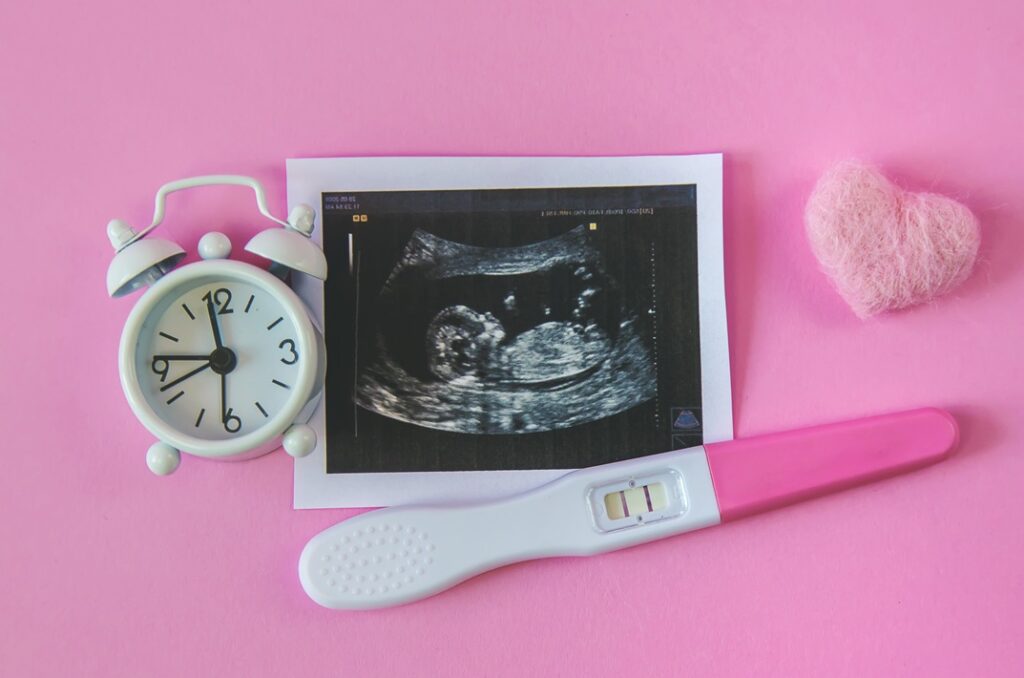
Do you think you may have experienced implantation bleeding and are eager to take a pregnancy test? You’ll still need to wait a few more days. At the time of implantation, levels of the hormone hCG, which is only produced during pregnancy, are still very low. A pregnancy test taken at that moment is unlikely to detect it.
Therefore, to avoid a false negative and obtain a more accurate result, it is better to wait a few days before taking the test. The time between implantation bleeding and a positive result is usually around 3 to 7 days, as this is how long hCG needs to reach detectable levels. For this reason, it is generally recommended to wait until there is a missed period for the test to be reliable.
What to do if you experience implantation bleeding
If you have had light implantation bleeding, there is no cause for alarm or further action.
If the bleeding lasts longer than expected, becomes heavier or more uncomfortable, or if you have any doubts about what is happening, it is best to contact your gynaecologist to confirm whether it is implantation bleeding or something else.
Also, remember to be patient before taking a test. The time between implantation bleeding and a positive result is only a few days.
Would you like a personalised fertility consultation?
If, after months of trying (even with signs of implantation bleeding) pregnancy is not confirmed, there may be an underlying fertility or implantation issue. At Clinica Tambre, both in Madrid and Alicante, we carry out personalised treatments and specific studies for each patient, with the aim of finding the best solution and helping you to fulfil your desire to become a mother. We have a medical team specialised in fertility that will accompany you through every stage, answering your questions and offering the personalised care you deserve.