

blog tambre
Can artificial intelligence help us predict how many euploid embryos a treatment might create?
 Victoria
Table of contents
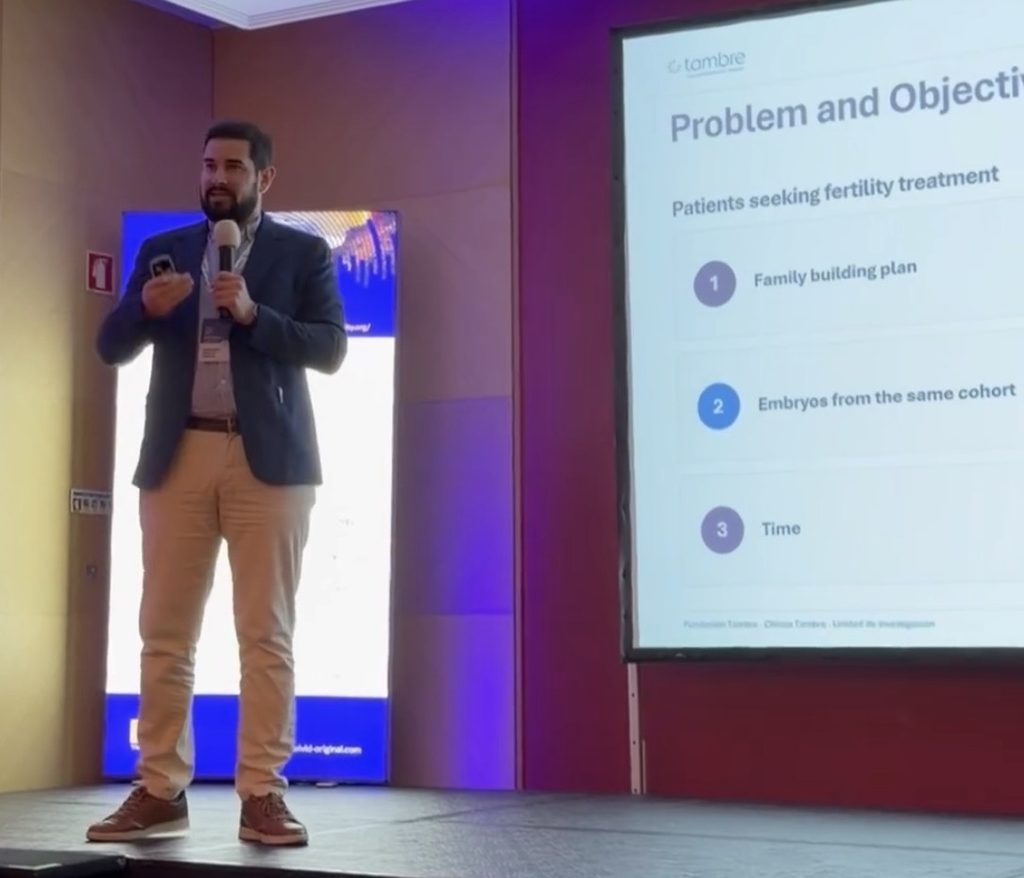
Will we one day be able to anticipate how many euploid embryos an assisted reproduction treatment might generate? This is one of the driving questions pushing some of the most innovative lines of research in the field of fertility. At Tambre, we have been working for years to find answers, and the results of one of our latest studies were recently introduced by Dr. Abraham Zavala, the clinic’s scientific director, at the AI Fertility (AIFS) World Conference 2026 in Cascais, Portugal.
The study, titled Comparative Machine Learning Algorithms for Predicting Embryo Euploidy Incorporating Sperm DNA Fragmentation in PGT-A Cycles, explores how different machine learning models can help predict the likelihood of obtaining chromosomally normal embryos—information that could help further personalize reproductive counselling for patients.
AI: A New Ally in Fertility
Artificial intelligence has already begun to make waves in reproductive medicine. Thanks to their ability to analyse huge amounts of data, these tools allow for the identification of complex patterns and the development of predictive models that could help increasingly personalize treatments.
One of the most promising applications would be to attempt to answer some of the most frequently asked questions by patients: How many embryos could be obtained in a cycle or what are the chances to get embryos with reproductive potential.
What did the study analyse?
Various treatment-related variables, including oocyte characteristics, semen parameters, and sperm DNA fragmentation were analysed by Tambre’s research team. Subsequently, different machine learning models were compared to evaluate which one offered the best predictive capability.d predictiva.
Medical assessment is not meant to be replaced; the goal is to explore the extent to which these tools can contribute to providing more personalised and tailored information to each patient.
Egg age is crucial
One of the most significant findings is the confirmation that the most influential factor in predicting reproductive outcomes is oocyte age. According to the researchers, this is a key variable in anticipating fertilization, embryonic development, and the likelihood of obtaining euploid embryos.
It was also observed that certain seminal parameters could influence early stages of the reproductive process. However, when analysing the attainment of euploid embryos, oocyte-related factors showed to have greater predictive importance.
Furthermore, models developed using our centre’s own data, maintained strong predictive accuracy when applied to new cases, reinforcing the potential of these tools to support clinical practice.
A key finding of the study was the model’s ability to predict outcomes for new cases with high accuracy. When compared to standard predictions based on patient age, the predictive model was found to be 30% more accurate.