

blog tambre
A day in the IVF laboratory at Tambre Alicante
 Victoria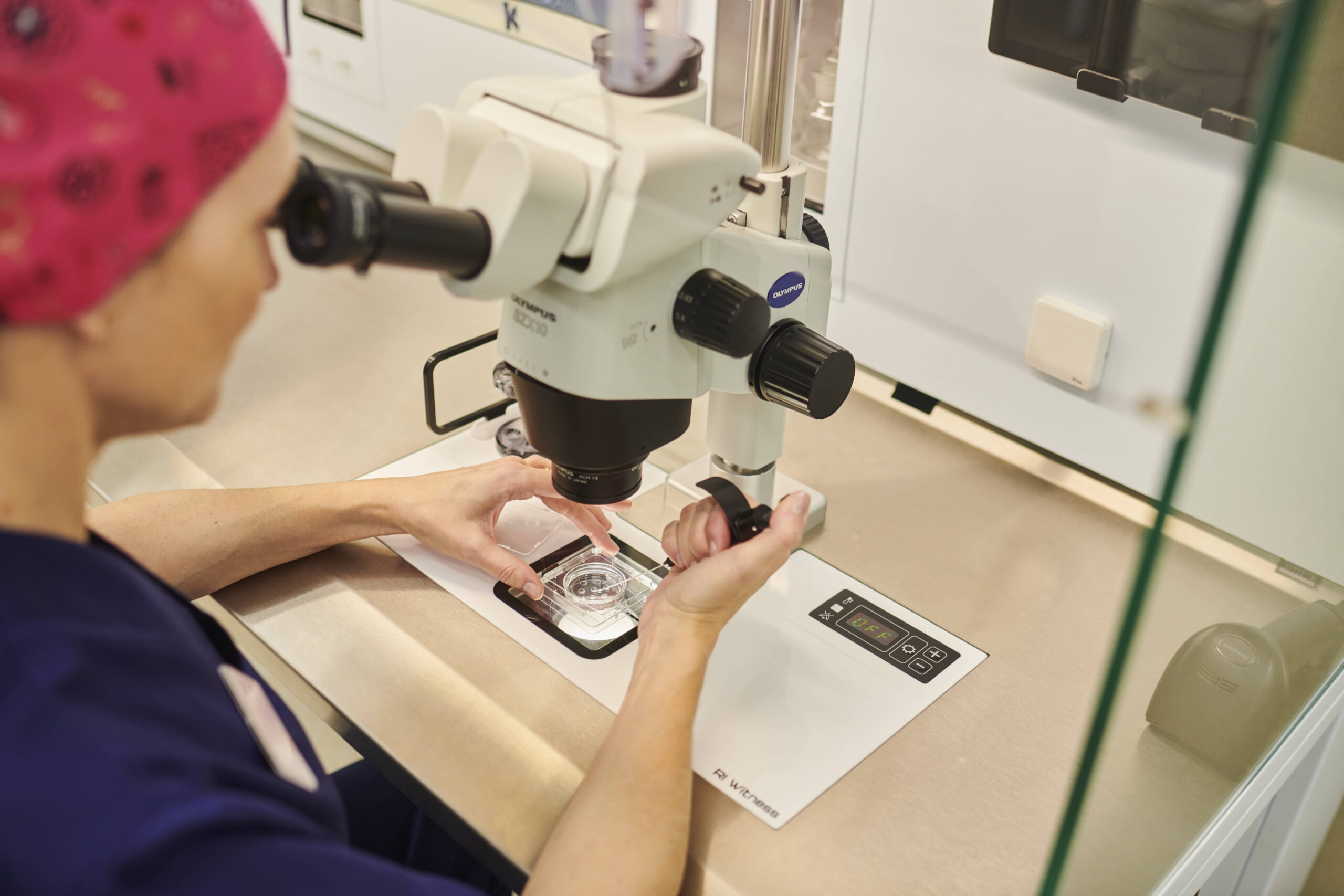
Table of contents
To mark Biology Day, celebrated every 25 January, we wanted to look where we rarely do: at the invisible heart of assisted reproduction.
There are spaces that are essential, yet rarely seen. Places where there is no noise, where time is measured in minutes — and sometimes in seconds. The embryology laboratory is one of them.
At Tambre Alicante, we spent an entire day alongside Leonor, Sara and Victoria. We observed their work as embryologists, learning about their processes and leaving with a deep sense of admiration. Because what happens here cannot be seen, but it is fundamental to making everything work.
The laboratory: where (almost) everything begins
The working day for our embryologists starts very early. By 7:30 in the morning, the laboratory is already fully operational. Before any procedure takes place, there are routines repeated every single day — small but essential actions that reflect precision and discipline.
Special clothing, a cap, and thoroughly washed hands. The laboratory is entered without perfume or make-up, to avoid altering the environment. Everything is designed to protect something extremely valuable.
In this video, we take you inside the IVF laboratory at Tambre Alicante to show you what a real day looks like, through the everyday moments that shape our work.
State-of-the-art technology, designed down to the smallest detail
The new laboratories at Tambre Alicante are spacious and filled with natural light. They have been designed with a clear purpose: to create the best possible environment for gametes and embryos — and also for the people who work with them.
These are state-of-the-art laboratories, directly connected to the operating theatre and the andrology laboratory. This allows for precise coordination and avoids unnecessary movement. Temperature consistency, stability and traceability are absolute priorities.
Here, we work with some of the most advanced media and materials currently available. Everything is designed to minimise cellular stress and to provide the best possible conditions at every stage of the process.
Observing embryos, making decisions
One of the first tasks of the day is to review and monitor embryonic development. We observe how embryos evolve in culture and, based on their stage, decide the next step for each one: continued observation, vitrification, biopsy or preparation for transfer.
CHLOE (AI support)
To support these decisions, in addition to the experience of our embryologists, at Tambre we work with CHLOE, an artificial intelligence system that helps us identify — always under the embryologist’s clinical judgement — which embryo has the highest potential.
These are highly technical decisions, but also deeply human ones. Behind every embryo there is a story, a patient, an expectation.
Absolute safety: knowing that this is the embryo
When the time comes to thaw embryos, everything becomes even more precise. Each sample is checked several times. At Tambre, we work with a double human witnessing system and a radiofrequency identification system called RI Witness, which guarantees complete traceability. Every detail is checked. Always.
Andrology: the other essential side
The andrology laboratory is another key part of the day. Here, semen samples are analysed for concentration, motility and morphology. We also perform sperm preparation and capacitation, as well as carefully controlled cryopreservation protocols.
From the operating theatre to the laboratory, without losing a single degree
One of the most critical moments is the retrieval of the oocytes. The patient enters the operating theatre for the follicular puncture and receives a light anaesthetic. At that precise moment, coordination between the operating theatre and the laboratory is absolute.
The oocytes arrive in heated tubes, one by one, to ensure that the thermal chain is never broken.
Embryologists often describe their appearance as a “fried egg”: the oocyte in the centre, surrounded by cells that protect and nourish it.
Preparing the oocytes, preparing the future
After retrieval comes decumulation, a delicate process that allows us to assess oocyte maturity. This is followed by ICSI, where the embryologist selects the sperm with the best quality and lowest DNA fragmentation and performs the injection with extreme precision.
Fertilised oocytes are then placed in culture media, where they will remain for five to six days as they develop.
The most anticipated moment: embryo transfer
When embryos reach the blastocyst stage, it is time for embryo transfer. The embryologist loads the embryo into the transfer catheter and accompanies it to the operating theatre, with every step designed to minimise risk.
After the transfer, the catheter is carefully checked to confirm that the embryo has reached its destination. And good luck is wished. Always.
The people behind every process
This report would not have been possible without Leonor Ortega, embryologist and Director of the Tambre Alicante laboratories, and embryologists Sara Ruiz and Victoria Almela.
Women with extensive experience, scientific rigour and sensitivity. Professionals who are a guarantee not only because of what they do, but above all because of how they do it.
What cannot be seen, but holds everything together.
Processes matter — but people matter even more. Every human and technical resource is placed at the service of each patient, with one shared goal: achieving a baby.