
blog tambre
Tambre participates in the SEF 2026 National Congress with 7 studies in reproductive medicine
 Victoria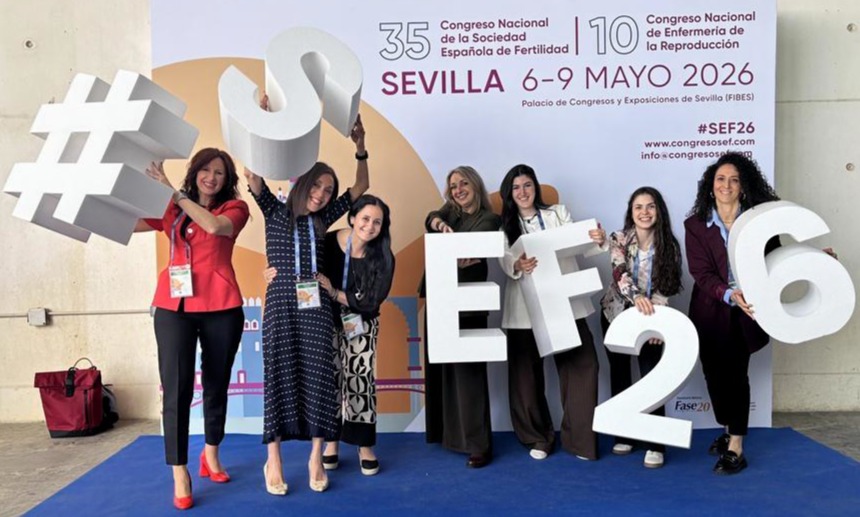
Table of contents
Every advance in assisted reproduction begins long before a patient reaches the consultation room. It starts in the laboratory, in the analysis of results, in the review of cases and in the questions the medical team asks in order to better understand what may be influencing a treatment.
From 6 to 9 May 2026, Tambre travelled to Seville as the city became one of the major meeting points for reproductive medicine in Spain, hosting the 35th National Congress of the Spanish Fertility Society (SEF) and the 10th National Congress of Reproductive Nursing. Over four days, specialists from across the country shared research, clinical advances and new lines of work that may help improve diagnosis, treatments and patient care.
In this edition, Clínica Tambre attended with a particularly strong scientific presence: 7 accepted studies, 5 of them as oral presentations and 2 as scientific communications, reflecting a clear commitment to research, innovation and the study of complex cases.
En esta cita, que se celebra cada dos años, Clínica Tambre acude con una presencia científica especialmente destacada: 7 trabajos aceptados, 5 de ellos como presentación oral y 2 comunicaciones científicas que reflejan una apuesta clara por la investigación, la innovación y el estudio de los casos complejos.
Part of the Tambre team travelled to Seville, including Dr Susana Cortés, Director of Tambre Laboratories; Dr Estefanía Moreno, fertility specialist gynaecologist; Sara Ruiz, embryologist at Tambre Alicante; andrologist Rachele Pandolfi; biologist Laura Serrano; Ana Ballester, Head of Nursing at Tambre Alicante; Raquel Urteaga, psychologist at Tambre; Inma Olid, Director of Expansion; and scientific advisor José Antonio Horcajadas.
This representation reflected the fact that assisted reproduction is a team effort involving doctors, embryologists, nursing staff and laboratory teams, all working in the same direction as research.
Research presented at the SEF National Congress
These studies reflect different lines of research developed by the Tambre team to better understand the factors that can influence assisted reproduction treatments.
Maternal age and IVF with own eggs
One of the studies analyses how, over ten years, the age of patients undergoing in vitro fertilisation (IVF) treatments with their own eggs has changed.
It is an increasingly common reality in consultation: many women come to assisted reproduction at a more advanced age, sometimes after years of trying to conceive, previous treatments or unresolved doubts. This study makes it possible to observe how this profile has evolved and why it is so important to speak clearly about real possibilities, biological limits and alternatives.
PGT-A in egg donation: when it provides useful information
Another of the studies focuses on the role of Preimplantation Genetic Testing for Aneuploidies (PGT-A) in egg donation treatments.
In cycles with eggs from a young donor, the use of PGT-A is not always systematically indicated. The study analyses when it may act as a complementary tool to select chromosomally normal embryos, reduce failed transfers, minimise miscarriages and plan treatment more effectively.
Artificial intelligence, embryos and oocyte age
Artificial intelligence (AI) is already being used in the embryology laboratory to analyse information on embryo development. However, its value depends on how that information is interpreted.
In this study, the team analyses morphokinetic parameters of early human embryos using time-lapse technology and AI. The aim is to better understand which variables influence embryo kinetics, such as embryo sex, chromosomal status or gamete age.
One of the most relevant points of the study is that it reinforces the importance of oocyte age as a key variable in predictive models. In practice, this helps to better interpret the information provided by new technologies and to continue refining embryo selection.
Country of origin and semen quality
This study analyses whether there are differences in semen quality according to the country of origin of men treated at an assisted reproduction centre.
To do so, the team retrospectively reviewed 13,251 semen analyses carried out between 2015 and 2025, from patients from Spain, the United Kingdom, France, Germany, Italy, the Netherlands, Switzerland and the United States. Parameters such as semen volume, sperm concentration, progressive motility and morphology were assessed according to World Health Organization (WHO) criteria.
The results showed statistically significant differences between countries, particularly in progressive motility, although the effect size was low. Overall, the study suggests that country of origin may influence a limited part of the observed variability in semen quality, but that this influence is modest and probably multifactorial.
Oral studies at the National Congress of Reproductive Nursing
In addition to the communications presented at the SEF National Congress, Tambre also took part in the National Congress of Reproductive Nursing with studies focused on care, prevention and patient support.
Endocrine disruptors and fertility
At the National Congress of Reproductive Nursing, Tambre presented a pilot study on exposure habits to endocrine disruptors, compounds found in some everyday products that may interfere with hormonal function.
The study analyses biological samples and habits of women of reproductive age to explore how this exposure can be addressed through health education and personalised support.
Elevated progesterone and oocyte maturation
During ovarian stimulation, different hormonal parameters are monitored in order to make safe decisions. One of these is progesterone.
This study analyses whether elevated progesterone on the day of ovulation triggering influences oocyte maturation. It is a relevant question because elevated progesterone has been associated with poorer outcomes in fresh transfers, mainly due to its impact on endometrial receptivity.
The study helps to differentiate whether the issue lies in the oocyte or in the endometrial environment. This distinction may be important in strategies such as embryo vitrification and deferred transfer.
Science that translates into better decisions
Tambre’s presence at SEF 2026 has a clear objective: to share research, learn from other teams and bring that knowledge back to the consultation room, the laboratory and the support provided to each patient.
Because research is not something distant from the patient experience. It is a way of looking more closely at each case, asking more precise questions and making more tailored decisions.
At Tambre, science does not remain at the congress. It returns to the consultation room.
Every case deserves an expert perspective
If you are looking for answers about fertility or need a second opinion, at Tambre we can support you with precise diagnosis, advanced technology and a team specialised in complex cases.