

blog tambre
PGT-A in egg donation: when it can provide useful information before embryo transfer
 Victoria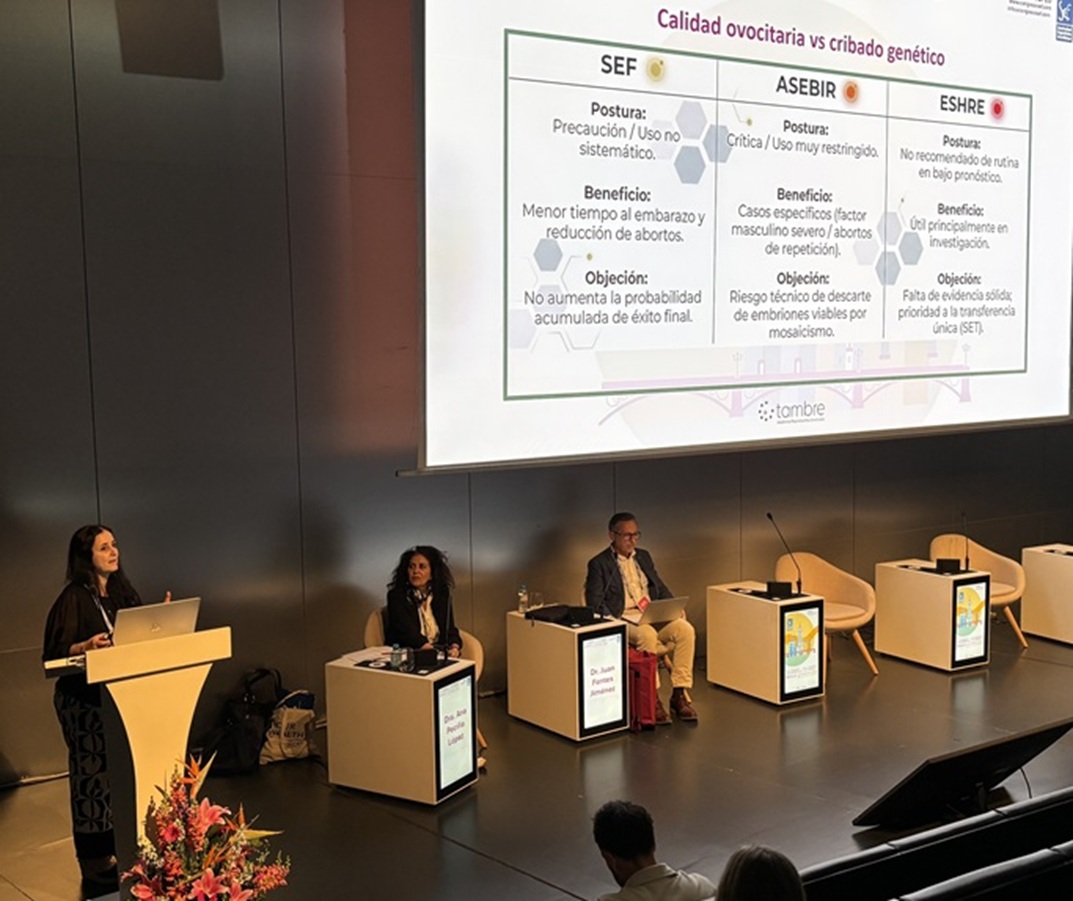
Table of contents
A common question in egg donation
In egg donation treatment, one question that may arise is whether it makes sense to genetically analyse embryos before transfer when the eggs come from young donors.
The answer is not always the same for every patient. Preimplantation Genetic Testing for Aneuploidies (PGT-A) can provide useful information in certain contexts, but its indication should be assessed with clinical judgement and not used as an automatic test.
With this question as a starting point, the Tambre team analysed the evolution and usefulness of PGT-A in egg donation treatments over the last decade. The study was selected for oral presentation at the 2026 National Congress of the Spanish Fertility Society (SEF), where it was presented in Seville by Tambre’s Laboratory Director, Dr Susana Cortés.
What is PGT-A and why is it debated in egg donation?
PGT-A makes it possible to analyse whether an embryo has the correct chromosomal makeup before transfer. Its use is more established in certain treatments with patients’ own eggs, especially when advanced maternal age is a factor.
In egg donation, however, its indication is more debated. The eggs come from young donors, in whom the incidence of chromosomal abnormalities in embryos is usually lower. That is why the question is not whether PGT-A is “good” or “bad”, but in which cases it can provide relevant information.
What the Tambre study analysed
The study reviewed 3,114 cycles carried out between January 2015 and December 2025, in cases with no associated male or genetic factor.
The study analysed the annual evolution in the number of egg donation cycles with PGT-A, the number of embryos biopsied per cycle, the rate of euploid embryos and the cases in which no euploid embryo was obtained after biopsy.
Main findings of the study
Between 2015 and 2017, egg donation cycles with PGT-A accounted for around 4% of all PGT-A cycles. From 2018 onwards, an increase in demand was observed, reaching its highest percentage in 2022, at 35.64%.
In recent years, this demand has gradually normalised and currently stands at around 15% of total cases.
The average number of embryos biopsied was 4.31 per cycle, with a euploid embryo rate of 64.41%. The study also identified 40 cases out of a total of 758 egg donation cycles with PGT-A in which no euploid embryo was obtained, representing 5.28%.
What this can offer patients
For patients, this study helps to better define the role of PGT-A in egg donation. It is not presented as a tool to increase the final live birth rate, but as a complementary technique that may help optimise embryo selection, reduce failed transfers, minimise miscarriages and support better treatment planning in certain cases.
Its value lies precisely in that: not applying technology by default, but assessing when it can provide relevant information for a specific patient.
The study concludes that PGT-A in egg donation has stabilised as a complementary technique and may help identify a real clinical risk, such as cohort failure, while also contributing to better treatment planning.
Efficacy of euploid embryo selection in oocyte recipients: Is PGT-A a necessary tool?
Authors:
S. Cortés Gallego, C. Cordero Rosales, L. Serrano Palomo, M. Manzanares Crespo, Á. Almoyna Mataix, C. Andrés Santé, R. Pandolfi, J. A. Horcajadas, L. Ortega-López.
Every indication matters
At Tambre, each treatment is assessed individually to determine which tests may provide useful information in each case and at what point in the process.
Discuss your case with our team